I was close to giving up and walking back to the car for a lukewarm cup of coffee. The Hoh Rainforest had already tested my patience. It’s a beautiful place, but it doesn’t make photography simple. Moss hangs from every branch, the air feels thick, and the ground looks like a thousand years of plants all growing on top of each other. Everything around you feels alive, but that doesn’t mean it always makes a good picture.
I had spent most of the morning trying to set up shots that fell apart as soon as I lifted the camera. One area was too busy, another had barely any light, and nothing seemed to come together. It reminded me of trying to take pictures of my kids when they were small. The second they noticed the camera, the calm moment vanished.
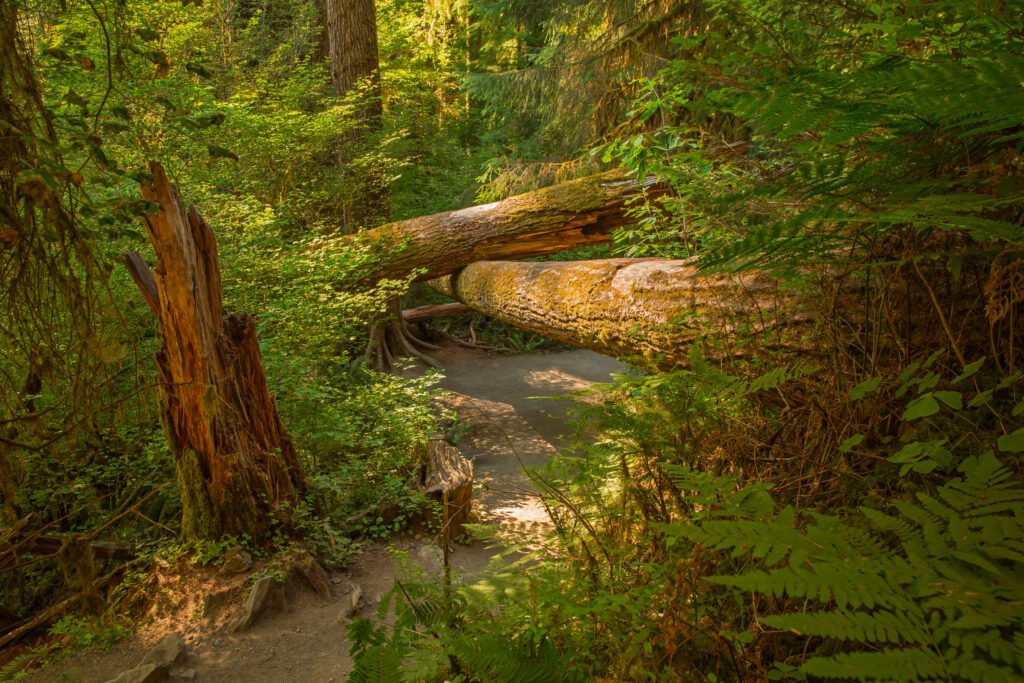
So I kept walking, not expecting anything special. Then I saw a narrow path I’m sure I hadn’t noticed before. Two fallen trees leaned over the opening like a crooked doorway. I ducked under them and stepped onto the trail, half wondering if I would find a nice photo or trip and twist an ankle instead. The path curved uphill, soft and quiet under my boots. For some reason I don’t fully understand, I stopped halfway up and turned around.
That’s when the sky opened.
The morning sun broke through for only a few seconds, but it was enough to change everything. The greens around me glowed bright and fresh. The moss looked like it had been waiting all year for that single flash of light. I rushed to set up my tripod, hoping the sun would hold on just a little longer.
I caught the shot just in time.
Moments like this don’t show up on command. They tend to arrive right when you’ve stopped hoping for anything at all. Maybe that’s the forest’s quiet test, to see if you’ll stick around long enough for the magic to happen.
I sometimes joke that travel days have a way of stealing a little dignity from you. By the time we reached Furnace Creek after three flights, a cab ride across Vegas, and two hours of squinting at desert roads in a rented camper, I wasn’t sure if I wanted to unpack my gear or just collapse face first into the nearest patch of sand. But exhaustion has never stood a chance against good light, and the February sun dropping toward the Panamint Range made the choice for me.
Checking in at the campground felt like moving underwater. The woman behind the counter was cheerful in a way I couldn’t quite process, and the clip of the pen sounded oddly sharp. Maybe that’s what happens when you’ve been awake for twenty hours. Everything gets louder except your brain. I remember glancing at the sky and noticing the shadows getting longer, and that was enough to snap me back into photographer mode. My wife gave me the knowing look she’s perfected over decades of these adventures, the one that silently says, “We’re going, aren’t we?” We were.
Zabriskie Point was the only place close enough to reach before the color drained out of the landscape. The drive felt quicker than it probably was, mostly because the adrenaline had kicked in and I’d stopped feeling the stiffness in my legs. When we got out of the camper, the breeze hit my face and carried that dry, almost sweet desert scent that always makes me feel like I’ve stepped into a memory I can’t quite place.
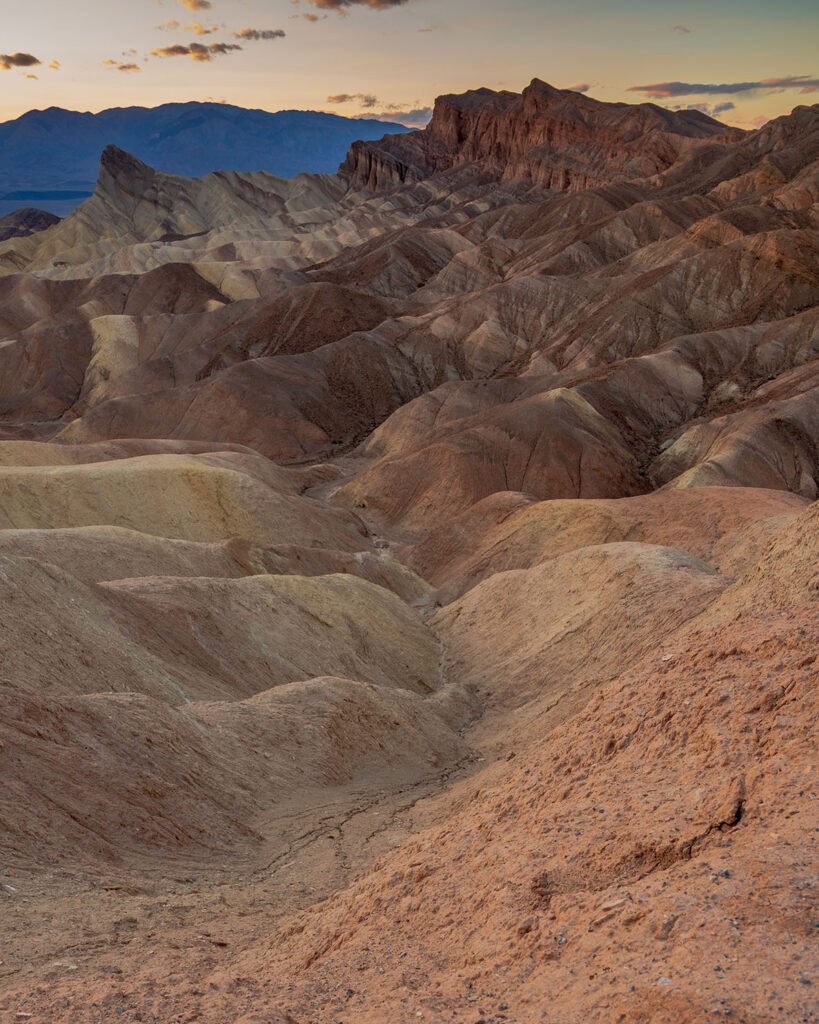
The short walk up the path gave us a view that somehow managed to wake me up more effectively than any nap could’ve. The badlands stretched out in folds and ridges, each one catching the late light in a slightly different way, like the earth was turning its face toward the sun one last time. There’s no polite way to say this, but I forgot how tired I was. Completely forgot. The excitement of seeing a new landscape for the first time doesn’t leave much room for complaints.
I spotted the composition almost instantly. A vertical frame with the foreground pulling the eye right into the heart of the valley. Clean, simple, honest. Sometimes I agonize over angles and framing, but that moment felt easy, like the land had already done the heavy lifting and I was just there to take notes. I fired a few test shots to settle my hands, then set up the tripod before the sun could slip any lower.
Looking back, the shot feels like more than a travel memory. It carries the weight of tired bones and stubborn joy, of choosing a moment even when your body wants a nap, and of remembering who you are when you’re standing in front of something bigger than you.
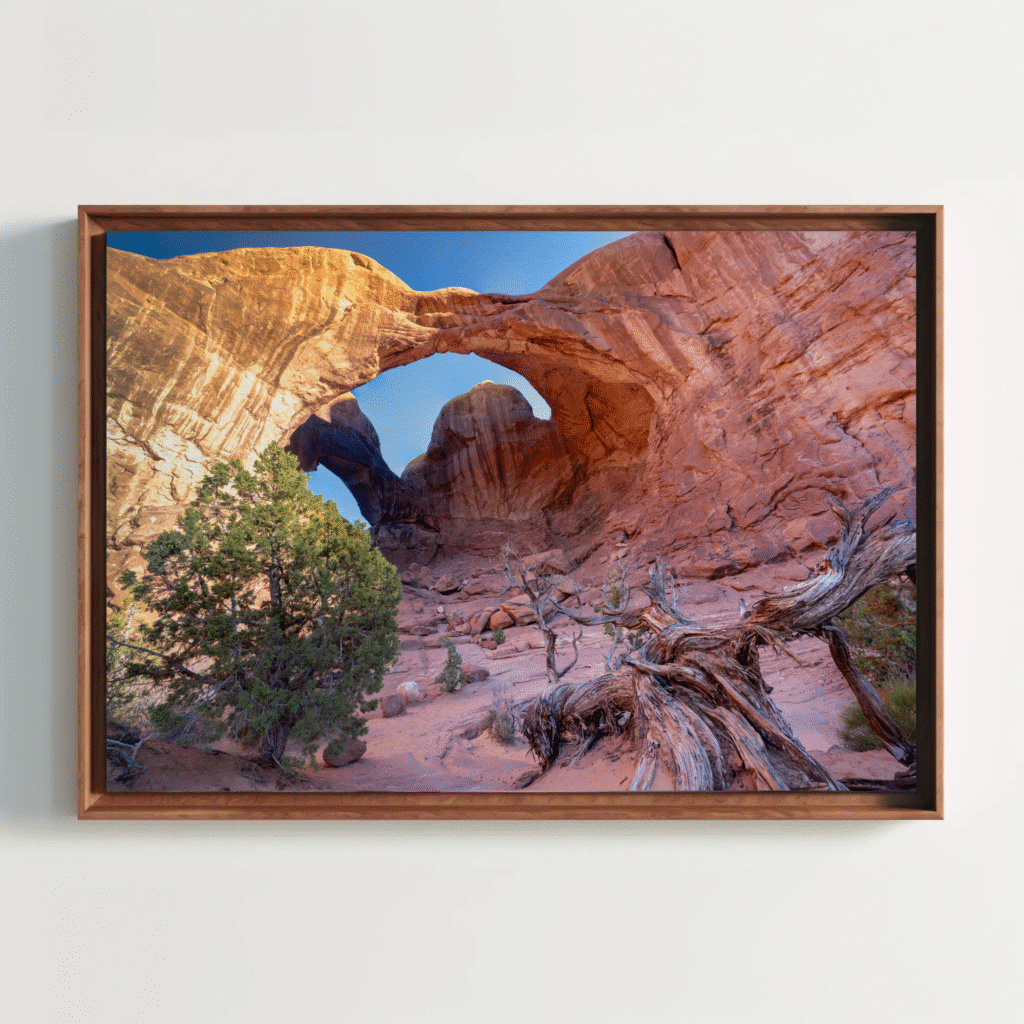
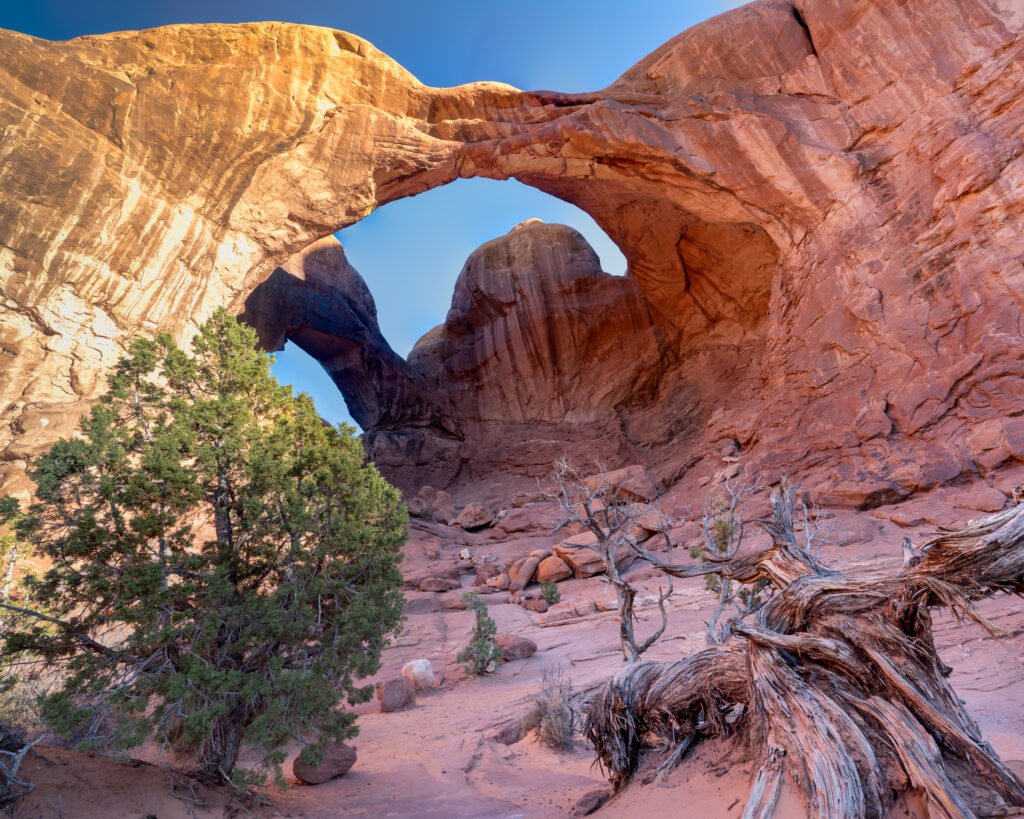
In 1983, I found myself standing at the base of Double Arch in Arches National Park—a young first responder with a bad ankle and an even stronger sense of wonder. The sandstone curves towered above me, glowing in the Utah sun, and I could already see the photograph I wanted to create. But between me and that perfect composition was a steep, uneven descent I simply couldn’t manage at the time. So I did what dreamers often do—I made a promise to return.
Years turned into decades. Life moved on, my ankle healed, and photography grew from a hobby into a calling. When I finally returned in 2017, eager to finish the story I’d started all those years ago, fate had other plans—the Double Arch area was closed for renovation. I left once more with the same unfinished dream echoing in my mind.
Fast forward to 2024. I made my third attempt, this time with experience and better gear. The light was perfect, the sky breathtaking—but my lens wasn’t wide enough. The shot I envisioned simply wouldn’t fit. I stitched together a panorama, only to discover later that parallax distortion ruined the image. Close, but not quite.
Then came 2025. A government shutdown threatened to close the parks, but Arches stayed open just long enough for me to try again. With my wide-angle lens and years of lessons behind me, I stood once more before those twin spans of stone. As I set up my tripod and looked through the viewfinder, I couldn’t help but smile—the juniper in the foreground had aged, twisted, and weathered, much like me.
This time, everything aligned. The light, the lens, the patience, and the quiet persistence that only comes with time. When I finally pressed the shutter, I wasn’t just capturing a landscape—I was honoring a forty-year promise to myself.
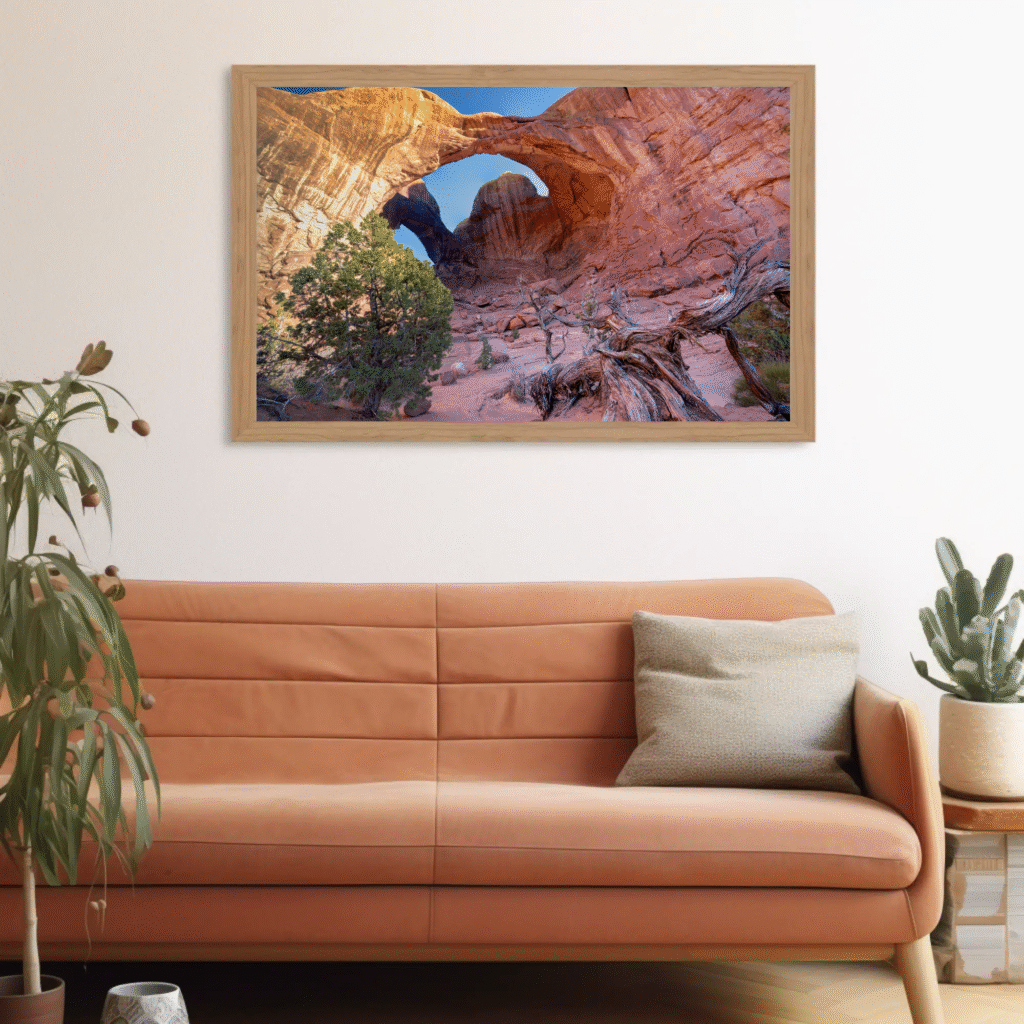
The finished image now hangs on my wall, not as a trophy, but as a reminder: some visions take decades to fulfill, and that’s what makes them truly worth the wait.
The Golden Gate Bridge is one of the most photographed landmarks in the world. Its soaring orange towers and sweeping span across San Francisco Bay are instantly recognizable, even when blurred or partially hidden. Yet sometimes the best photographs aren’t about capturing the obvious view, but about finding a new angle that feels both familiar and strangely unfamiliar.
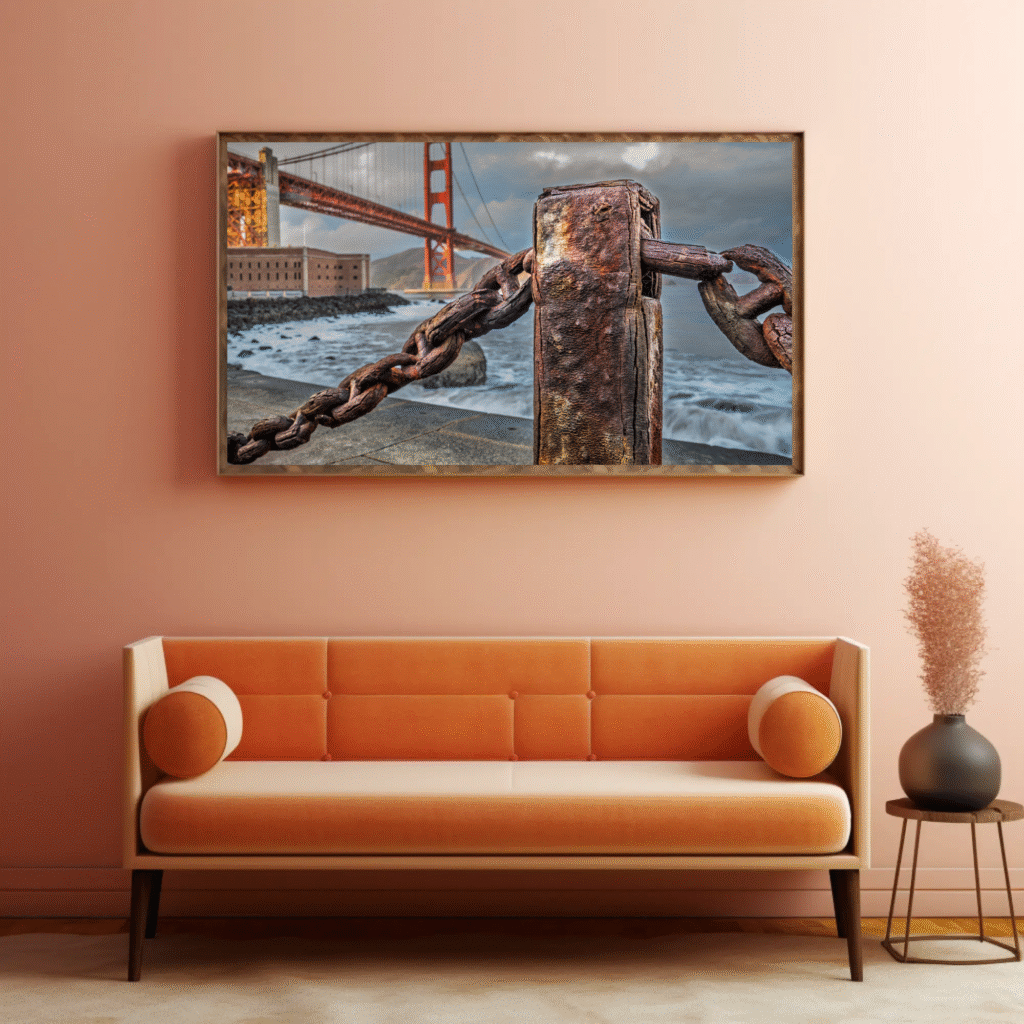
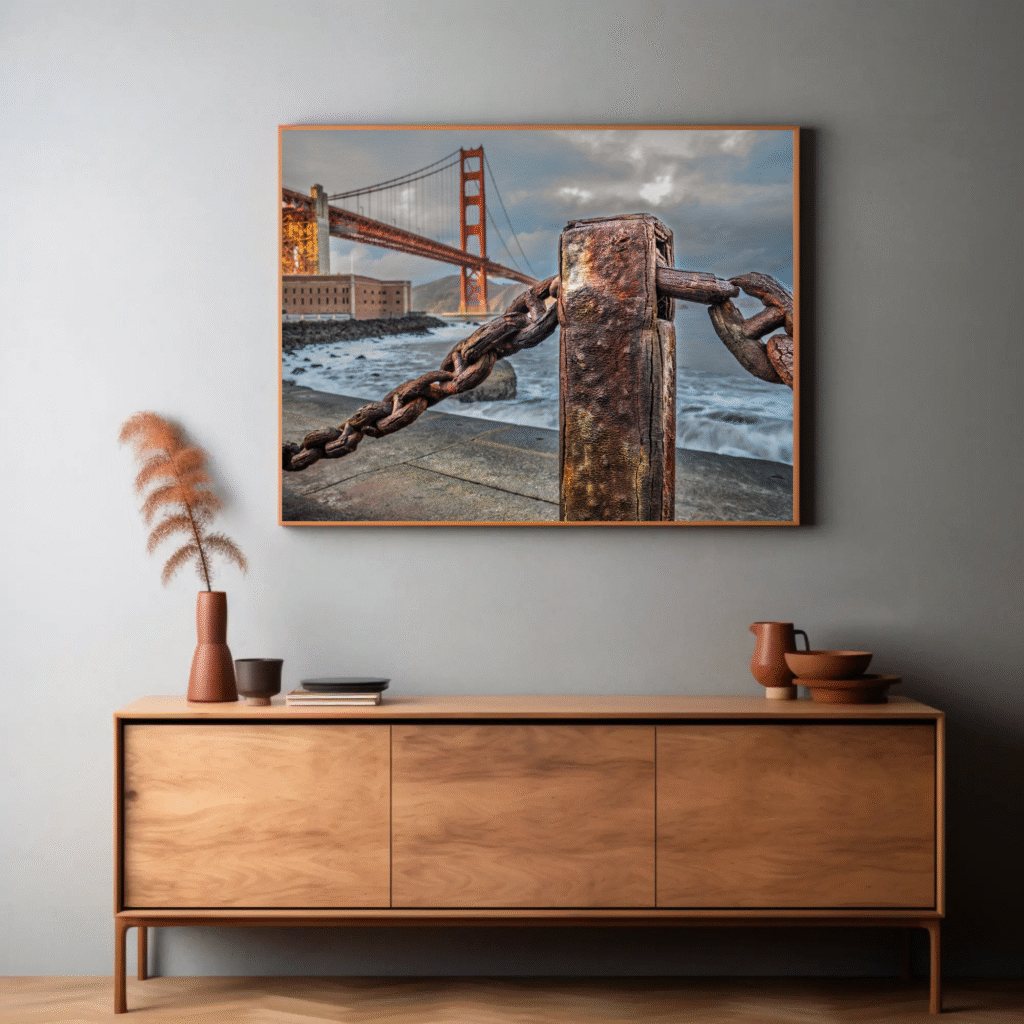
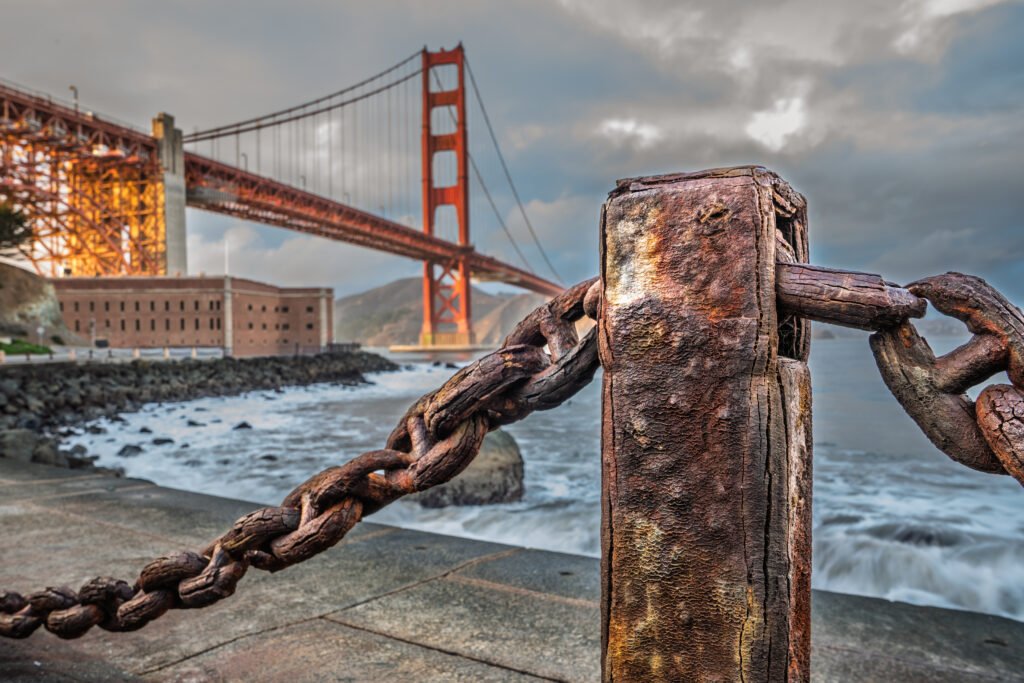
That’s exactly what happened on this walk along the shoreline. Instead of aiming my camera directly at the Golden Gate, I found myself drawn to a rusted chain post, weathered by years of salt spray. What started as a casual stop quickly turned into a lesson in patience, balance, and composition.
Finding Beauty in Rust and Texture
We hadn’t planned this shot. My wife and I were wandering near the waterfront when I noticed the massive chain, corroded and clinging stubbornly to its post. The textures were impossible to ignore—flakes of rust, cracks in the steel, and the unmistakable weight of time.
I started circling the subject like a hawk. Crouch low, shuffle sideways, lean forward, back up—each small movement shifted the balance between the rusty steel and the blurred Golden Gate Bridge behind it. It was a compositional tug-of-war between decay and triumph, and I wasn’t sure which one would win.
The Struggle Behind the Shot
Of course, composing the image wasn’t the only challenge. The ground was slick with salt water, which made kneeling impossible. So there I was, bent over at the waist like an aging gymnast attempting a warm-up routine. At 60, my back, knees, and balance all decided to betray me at once. Each adjustment of the tripod felt like an Olympic event. My wife, ever supportive, kept her distance—probably so she could honestly say later, “I have no idea who that man was wobbling like a folding chair about to collapse.”
And yet, the struggle made the final composition all the more satisfying. The rusted chain claimed the spotlight in sharp detail, while the bridge softened into a hazy silhouette in the background. It wasn’t the classic postcard view, but something more personal: a photograph about endurance, time, and the beauty of contrasts.
An Unfinished Conversation with the Golden Gate
Even as I packed up my gear, I knew I’d want to return. I imagined this same scene in blue hour, with the bridge’s lights glowing against the twilight sky, the chain still anchoring the foreground. For now, though, I carry this image as both a small victory and an unfinished conversation with the Golden Gate.
It’s a reminder that fine art photography isn’t just about capturing perfection. Sometimes it’s about the weathered details at your feet, the unexpected textures, and the willingness to bend—literally—to find a new perspective.
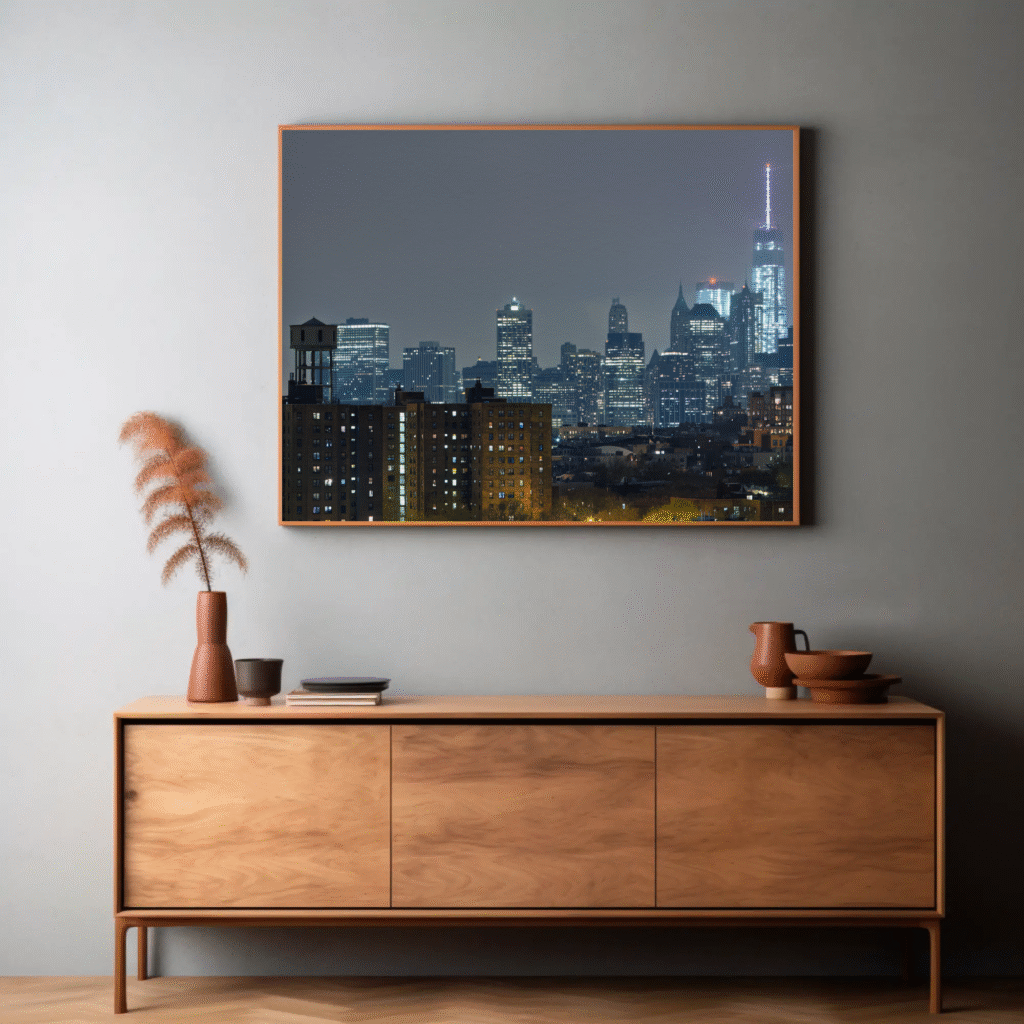
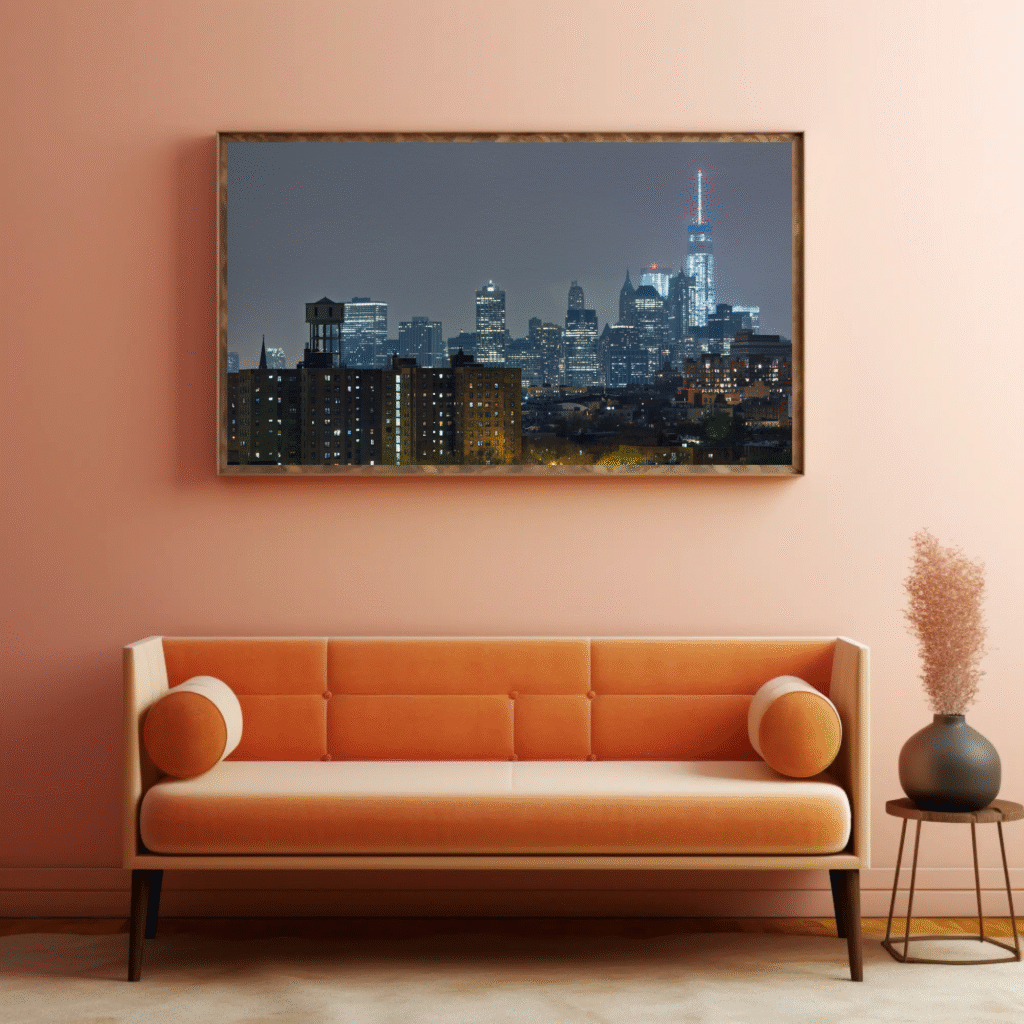
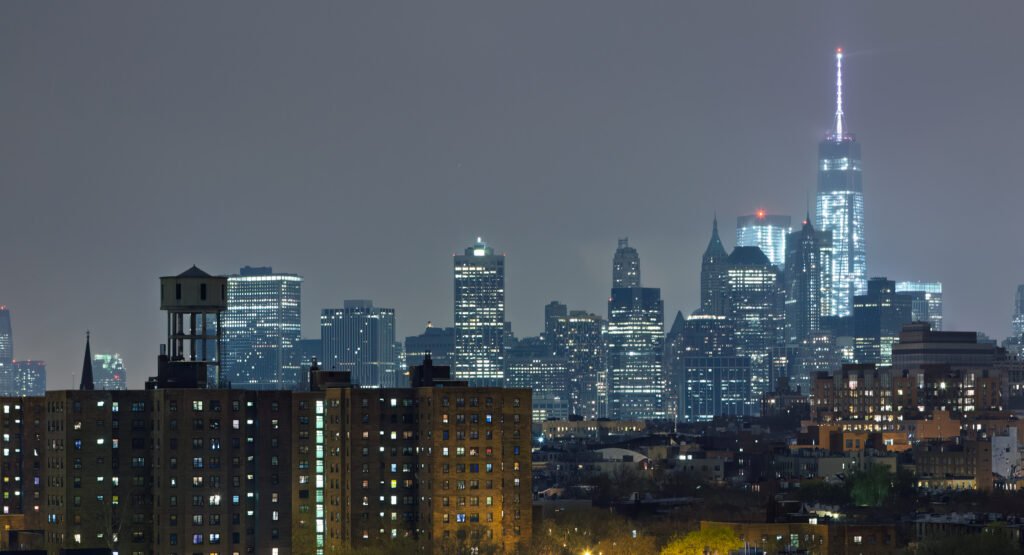
There are certain trips that linger in your memory long after the bags are unpacked. One of those for me was a long weekend in Brooklyn with the kids. We filled the days with subway rides, pizza slices, laughter, and the kind of endless walking that only New York City demands. But for me, some of the most meaningful moments happened at night—alone on the rooftop of our Brooklyn hotel, camera in hand, staring out at the glittering Manhattan skyline.
I must have slipped up there half a dozen times that weekend, drawn by the energy of the city that never seemed to sleep. The view was breathtaking—towering buildings, thousands of glowing windows, and the Freedom Tower shining like a beacon above it all. One night around 11 p.m., I captured the photograph you see here. It wasn’t just another picture of New York City; it became a time capsule of who we were then as a family.
That night, as I quietly put on my jacket, my oldest stirred and asked, “Where are you going, Dad?” I whispered back, “To take pictures of the city.” She blinked, smiled, and said something that has stayed with me all these years: “Camera on, dude.”
It was such a simple phrase, but it felt like a reminder to stay present. To keep noticing. To hold onto the fleeting beauty of family, travel, and the small in-between moments that slip away too quickly.
Looking back now, with the kids grown and living their own lives, I treasure that Brooklyn rooftop even more. The city skyline is timeless, but our time with our children is not. The photograph reminds me that life, like New York at night, is brilliant and fleeting. It’s a gift to be noticed, captured, and remembered.
Looking into Lower Manhattan from a rooftop in Brooklyn at night in foggy weather with the Freedom Tower
So whenever I see that image, I hear my daughter’s voice again: “Camera on, dude.” And I remember to keep the lens open—not just on the city, but on the moments that matter most.
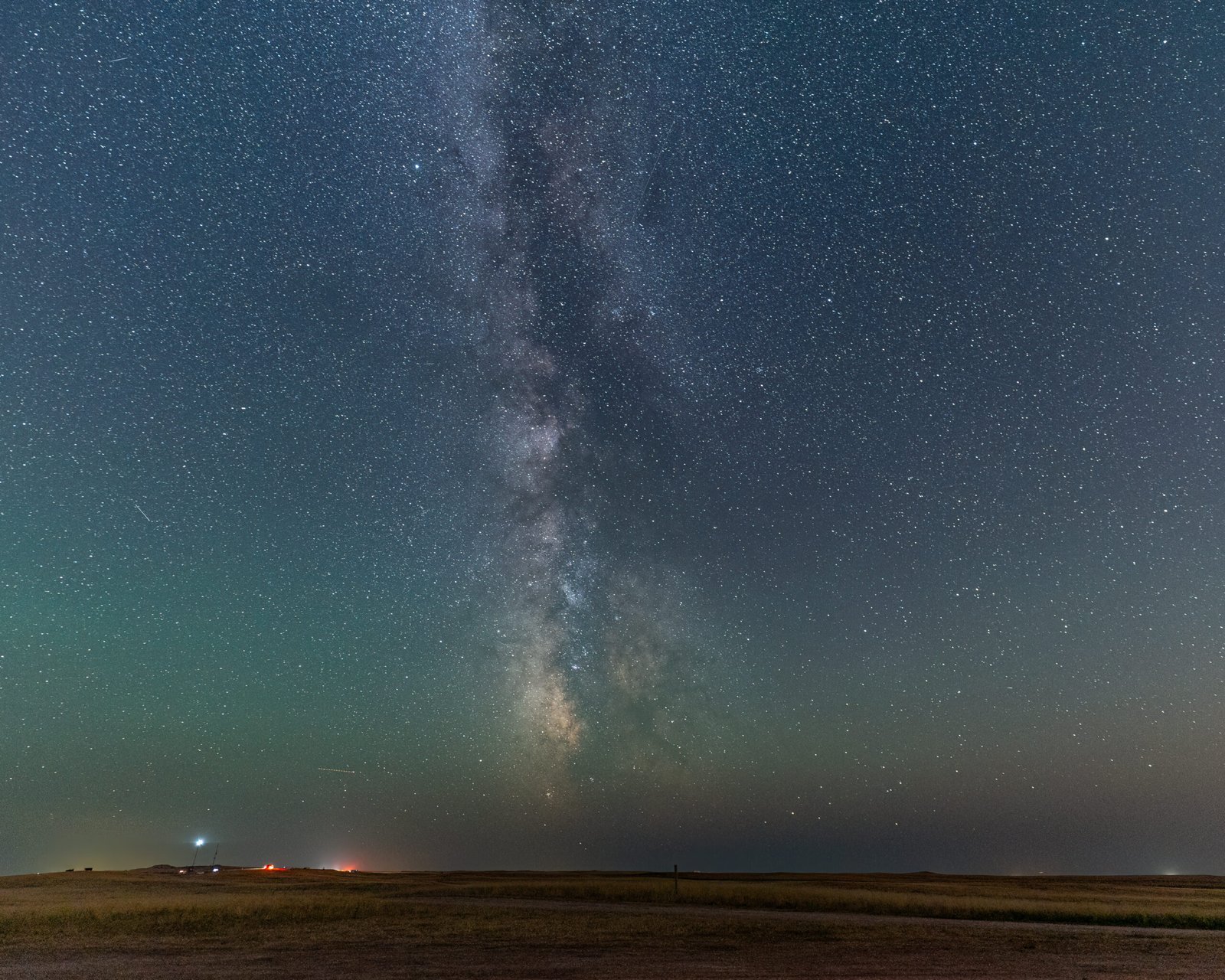
After a long day of RV travel and setup just outside of Badlands National Park, I found myself drawn back outside as twilight gave way to night. The air was still, and the last sliver of golden light clung to the western horizon as I set up my gear. The park’s surreal landscape may be its daytime claim to fame, but after dark, the sky steals the show.
As the light faded, the stars began to pierce through—first a few, then hundreds, then thousands. The Milky Way arched overhead, its galactic core burning bright in the southern sky. It always amazes me how alive the night can feel in these remote places. There was no wind, no traffic—just the hum of my intervalometer and the sudden, haunting howls of coyotes echoing in the distance. It’s that kind of eerie sound that makes your neck tingle, even when you know you’re safe. I found myself subconsciously drifting closer to the camper, the glow of its interior light a quiet comfort in the dark.
In this photograph, I tried to capture not just the sky, but the feeling of that moment. The open prairie, lit faintly by starlight, adds context and contrast to the brilliance above. The soft lights on the horizon remind us of the few others out there, tucked away in their own corners of the dark. It’s a reminder that beauty doesn’t just live in national parks or famous overlooks—it lives in the spaces between, in the quiet, forgotten stretches of the land, where the night sky tells its ancient story to anyone willing to look up and listen.
That’s how long it took us to tow our RV from the misty forests of New Hampshire, across endless ribbons of interstate, through seas of cornfields and roadside diners. Somewhere along the way, our GPS betrayed us, steering us straight into the tangled surface streets of downtown Chicago—at rush hour.
It was chaos. The kind of chaos only an RV weaving through brake lights and potholes can create. Nerves frayed. Tempers tested. We spent that first night curled up in a corner of a Walmart parking lot, the distant drone of semi-trucks lulling us into an uneasy sleep.
But then, everything changed.
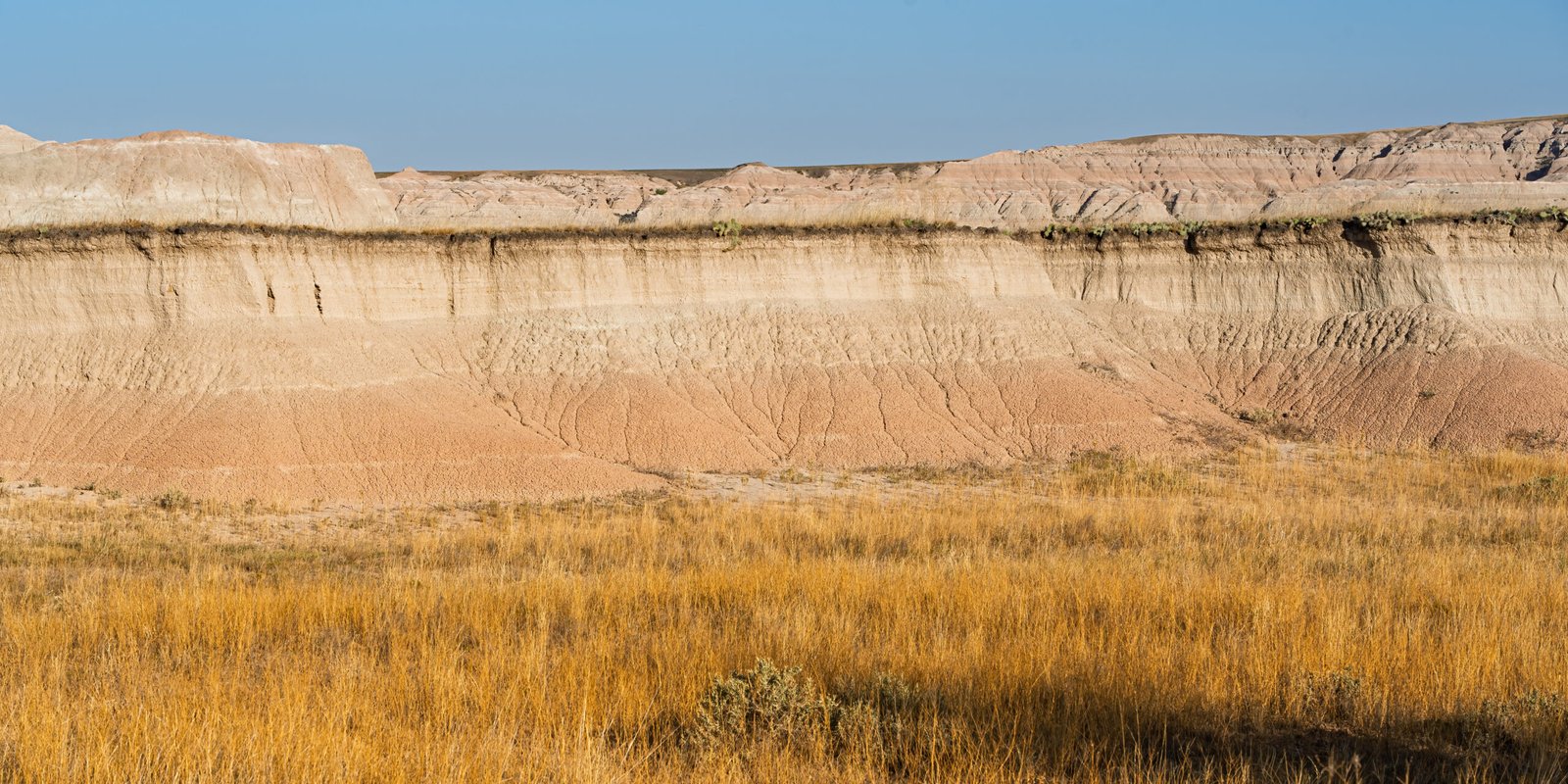
As we rolled into Badlands National Park the next morning, it felt like the world exhaled. The scenery shifted from flat monotony to something ancient and raw. Golden grasslands rippled in the breeze. Eroded cliffs rose from the earth like the exposed bones of forgotten giants. The air felt different—clearer, quieter. Time slowed.
All the stress of the journey melted away.
This image—“Layers of Time”—was taken not long after that soul-restoring moment. Bathed in the soft glow of late afternoon light, I stood in stillness, taking in the elegant complexity of the land. The amber grasses in the foreground, the weathered textures of the canyon wall, the subtle gradient of the sky above—it all spoke of deep time. Of endurance. Of change. Of natural beauty shaped not in hours or days, but in centuries.
It reminded me that journeys—whether cross-country or internal—rarely go as planned. But sometimes, a wrong turn leads exactly where you need to be.
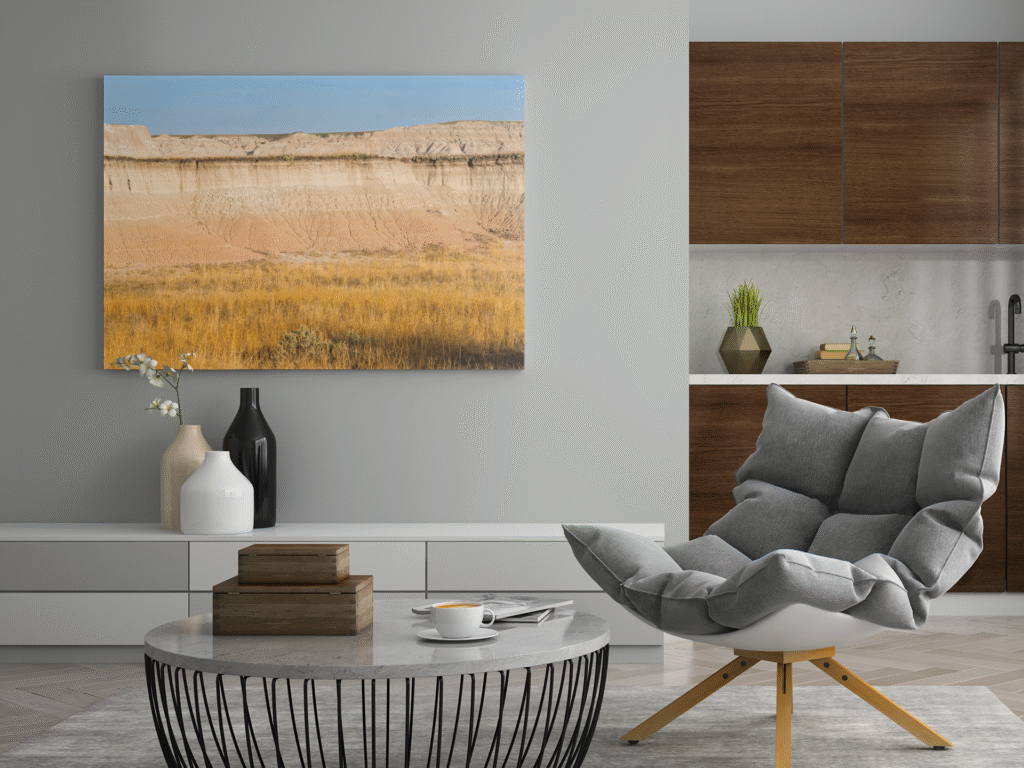
Why This Print Belongs in Your Space
“Layers of Time” isn’t just a photograph—it’s a moment of arrival. A meditation in warm earth tones and quiet textures. Whether you’re decorating a rustic cabin, a minimalist office, or looking for a gift for the National Park lover in your life, this image brings with it the spirit of exploration and the serenity of wide, open spaces.
Perfect for:
Rustic or minimalist interiors
Gifts for road trippers, explorers, and National Park enthusiasts
Meditation rooms, studios, or calming workspaces
Printed on archival-quality materials to preserve the richness and detail of the landscape, Layers of Time serves as a daily reminder that beauty often lies just beyond the struggle.
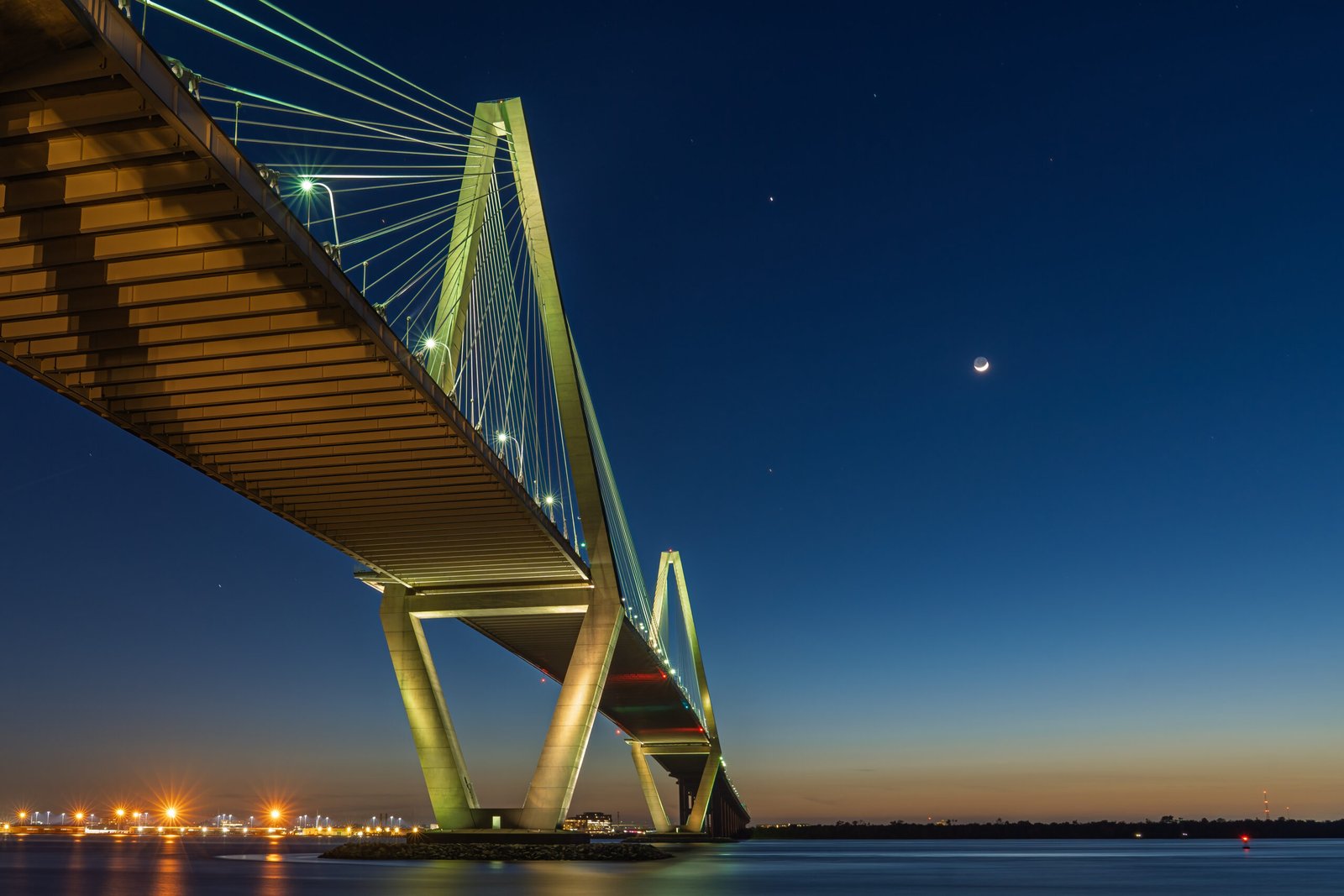
This photograph is more than just a still frame—it’s one of 700 captured over the course of a time-lapse shoot during blue hour at the iconic Arthur J. Ravenel Jr. Bridge in Charleston, South Carolina. I spent the better part of the evening watching the sky fade from indigo to deep navy, the crescent moon rising perfectly into position, and the bridge lights coming alive one by one. It was a dance between steel, sky, and patience—and I was lucky enough to be there for all of it.
What I didn’t expect, however, was to become part of the evening’s entertainment.
As I stood there behind my tripod, locked into position for the long haul, people kept wandering over with their phones out. Some smiled, others quietly hovered, and eventually someone stepped right next to me and asked if they could snap a selfie from my exact spot. I was a little surprised, but asked why. Their response? “Well, you look like a pro, so you must have the best angle.”
I guess I was flattered. Maybe it was the tripod. Maybe the camera. Maybe just the look of determined focus that only comes with battling swarms of mosquitoes for hours for the sake of the shot. But they weren’t wrong—this vantage point, with the graceful curve of the bridge stretching into the horizon and the moon resting perfectly in frame, was hard-earned and deeply considered.
This print captures a moment of structure meeting serenity—an architectural marvel grounded in steel and light, set against a sky that refuses to be anything but magical. It’s perfect for anyone who’s stood in awe beneath a bridge or has ever trusted the journey that comes from standing still.
To take a closer look at this image, please click here to see it in my Etsy Shop. There is no obligation.
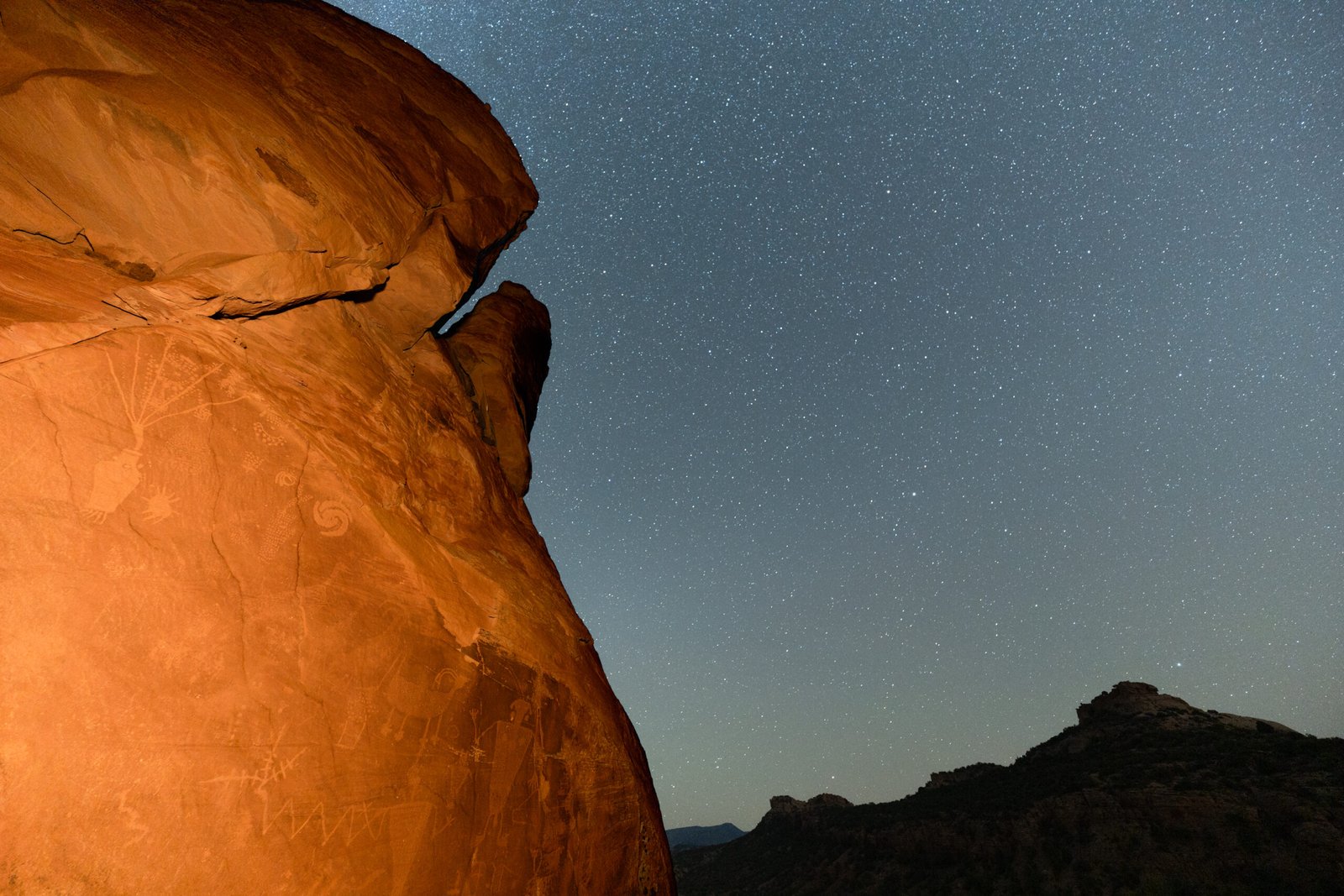
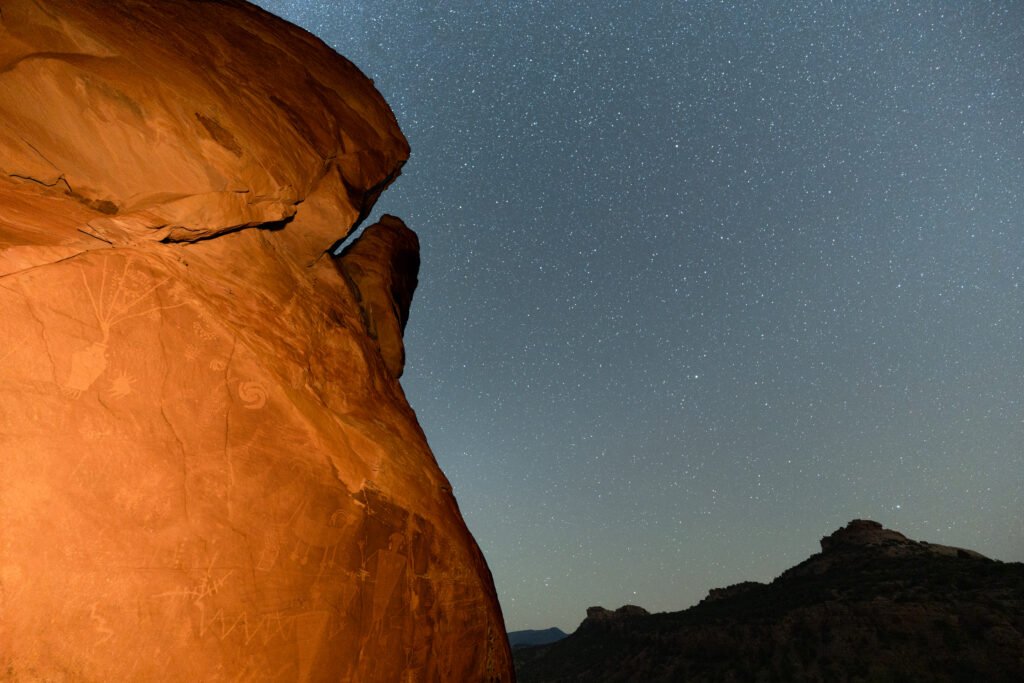
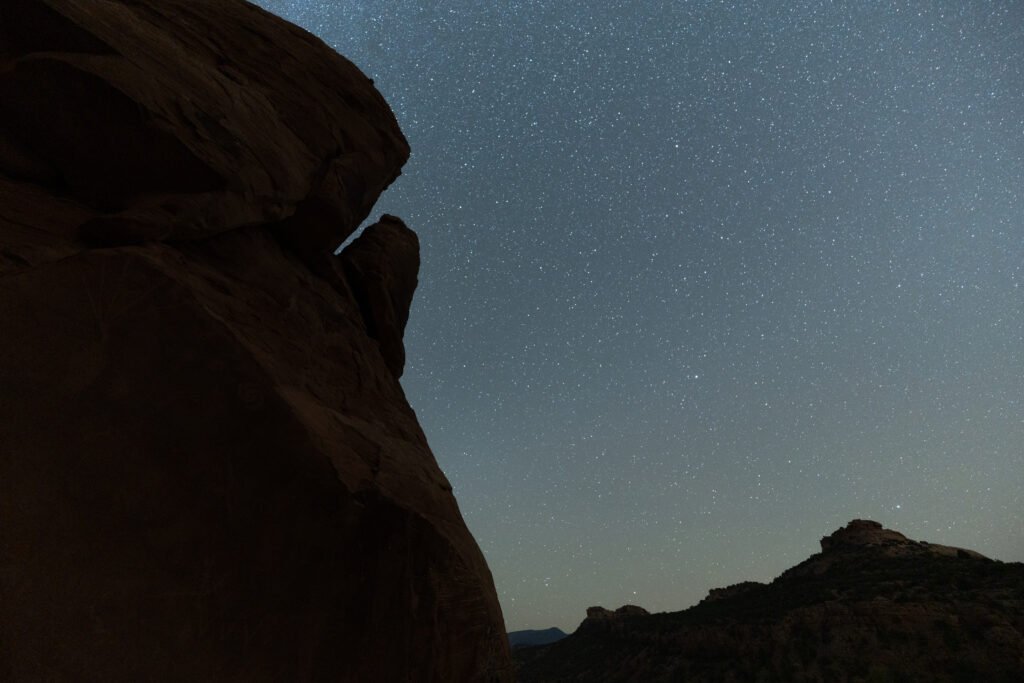
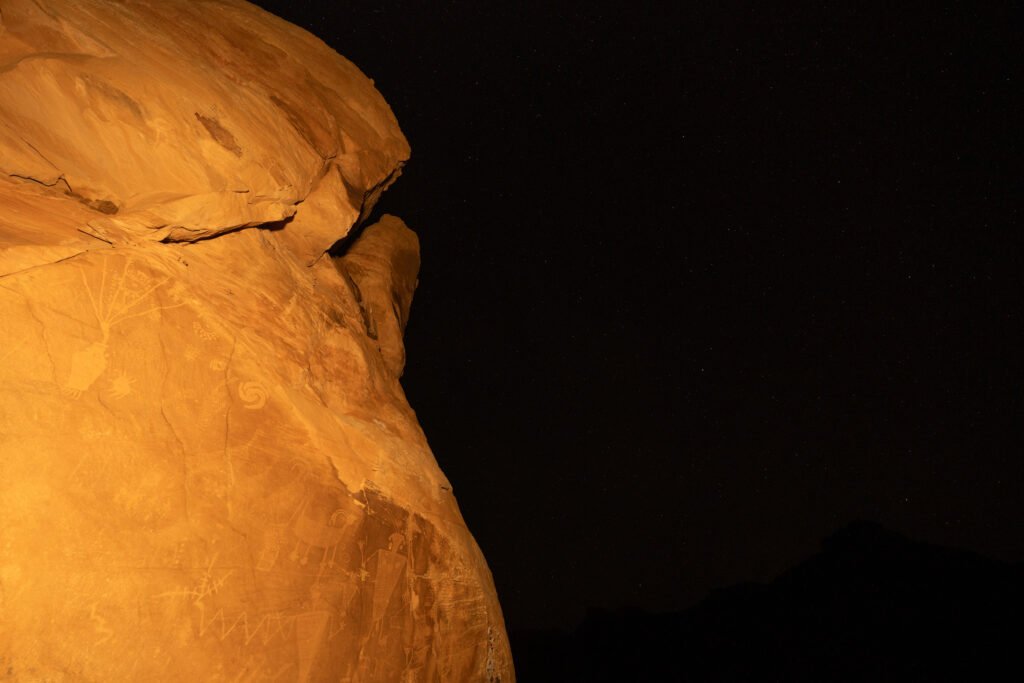
I am not sure this image will ever win a photography contest, but as soon as we get home, it is getting printed and will forever hang on our wall. It is a composite of two images taken moments apart on a fixed tripod. As you can see, there is a frame for the rock covered in ancient petroglyphs and a frame for the stars. I could easily Photoshop in a galactic core image showing the brilliant center of the galaxy, but for me, that would ruin the picture.
The Sky shot for over fifteen seconds at 2500 ISO
The rock shot with a bit of warm light from a Lumicube
I always have, and most likely always will have a primal fear of the darkness in the wild. It took a lot of courage and the company of my wife to drive miles out on a dirt road in total darkness, hike up a cliff and set up the tripod to get this image, but here it is.
The real story is not that Anita sang showtunes to keep the animals away; it is not the technical aspects of the photograph. It isn’t even how it turned out. Even though I love it, I know there are better conditions to get this shot in.
The real story is what happened as we got back to the truck. As we made our way off the cliff and onto the dirt road, I looked to the Northwest as saw exactly what I expected, the galactic core. What I didn’t realize was how perfectly it was aligned with the dirt road. I said to Anita – One more shot, even though I knew I would have to get one of the stars and then play around lighting the road as if it led directly into the milky way.
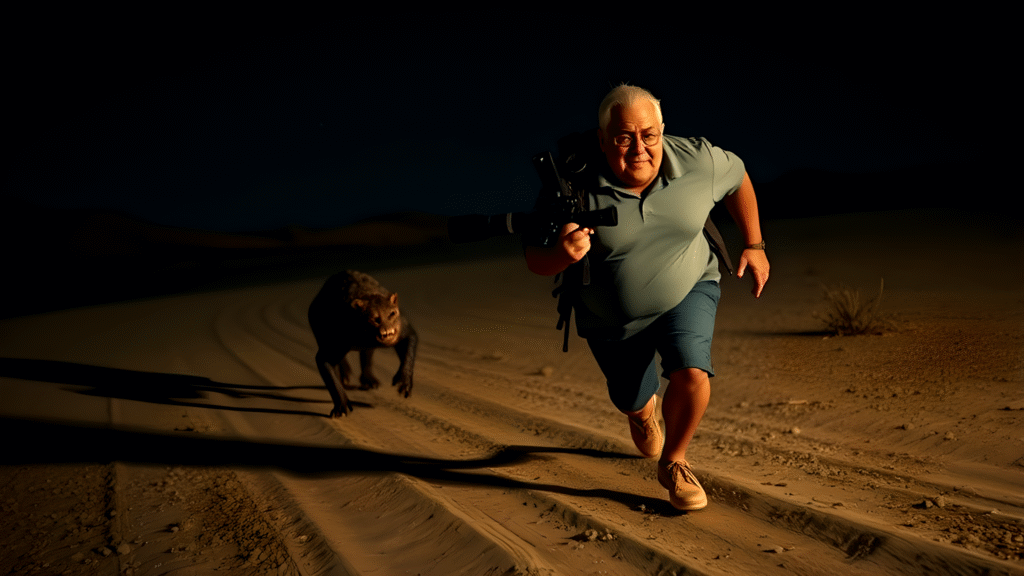
I managed to get the tripod legs extended and then it happened. As Anita was starting another show tune, we both heard a guttural growl with a bit of a trilling at the end. It was close. We disagree on how close, but I would say less than 100 feet. Anita thought closer.
“GET IN THE TRUCK!” I said softly and calmly. NO, not my side, get in the passenger seat. “You get in the passenger seat” she calmly replied. Just as I was about to formulate a very convincing argument that she should go around the truck, closer to the gentle, harmless animal that made the noise, I saw Anita climb over the center console a swiftly as a Pronghorn Antelope. I then realized there was no need for an extended dialog about the matter. I quickly, not as quickly as she jumped in the passenger seat, but quickly threw the tripod in the back of the truck and took my rightful place in the driver’s seat. I was relieved when the truck started. The windows were up, the truck was running, and the lights were on. There was no need for all the adrenaline…the adrenaline kept flowing. We were about half a mile down the dirt road when we both started laughing.
Was it the ghost of an ancient artist objecting to Anita regaling the wilderness with modern music? Was it a mountain lion? What about a black bear? We will never know.
All I know is that this photo will always hang on our wall and forever remind us of the night we got up the courage to go deep into the wild night and got scared $#!t-less.
Photography for me can be relaxing, exhilarating, and is always therapeutic. This encounter took it to a whole new level, but I am grateful for the experience.
To view this image in more detail or purchase it, please visit my Etsy store click here to go directly to the image.
Congratulations on your new listing. Preparing a home for real estate photography requires careful attention to detail to ensure the property looks its best and photographs well. Here is a detailed guide based on key considerations for agents:
1. Declutter Key Areas
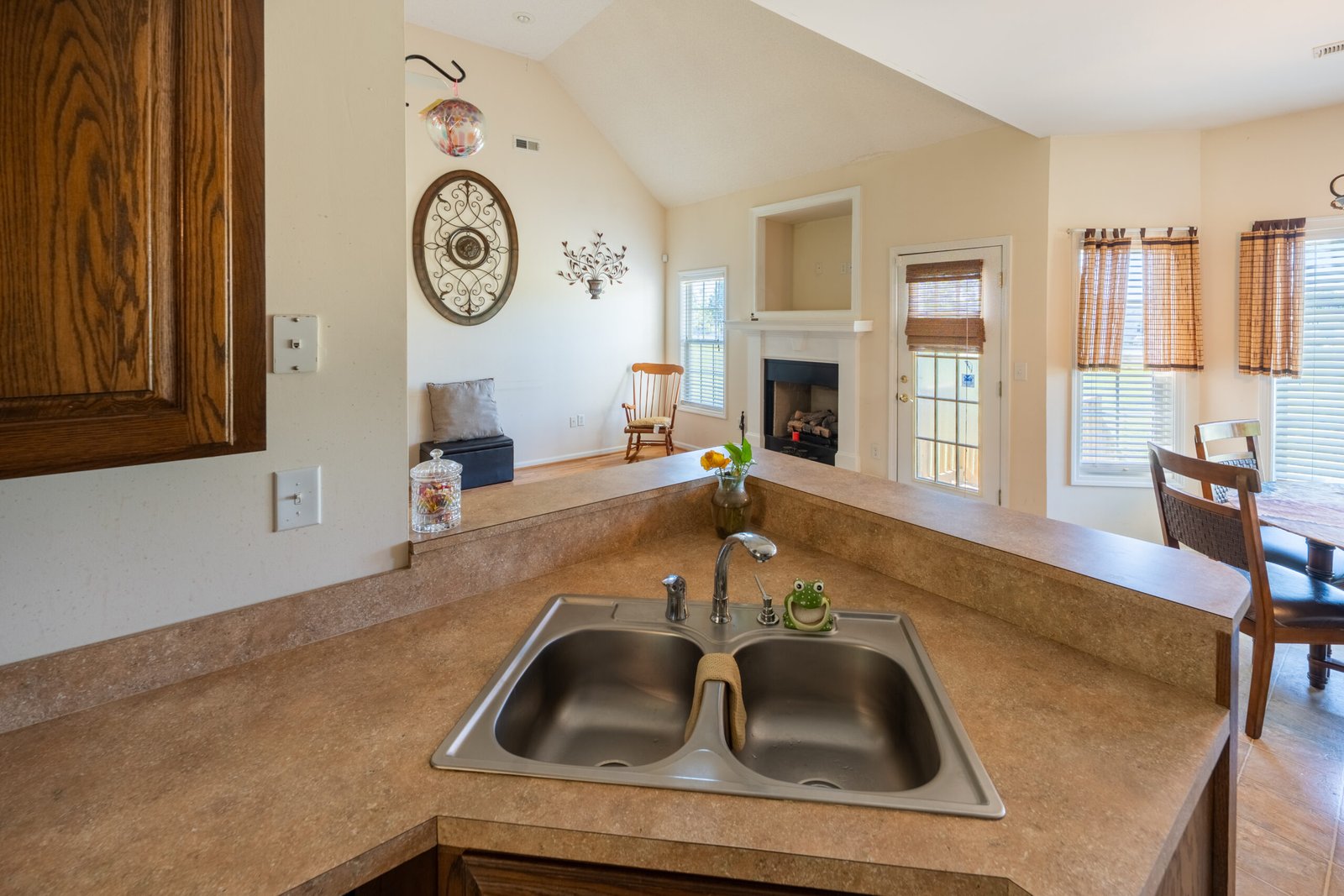
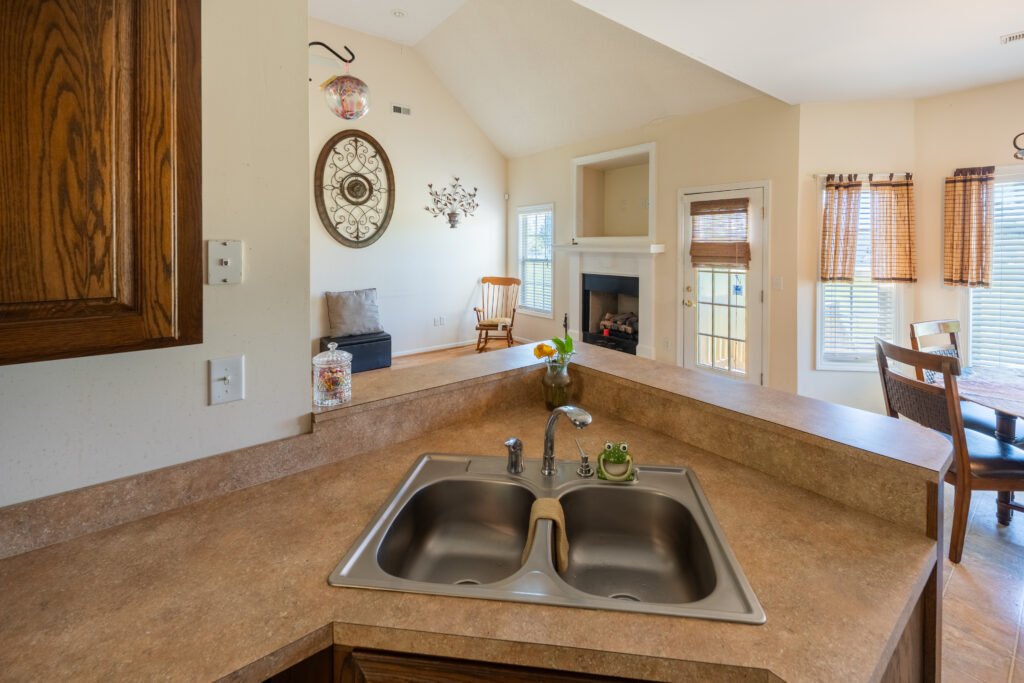
Focus on clearing spaces that tend to look cluttered and can distract from the home’s features. Prioritize kitchen counters, bathroom counters and shower areas, tops of bedroom dressers, and laundry rooms. These surfaces should be clear of personal items, kitchen appliances, toiletries, and laundry clutter.
2. Cleaning Tasks
Make sure to dust all surfaces and remove any general trash throughout the home. A spotless environment helps convey a sense of care and cleanliness, which can greatly enhance the appeal in photos.
3. Exterior Vehicle Removal
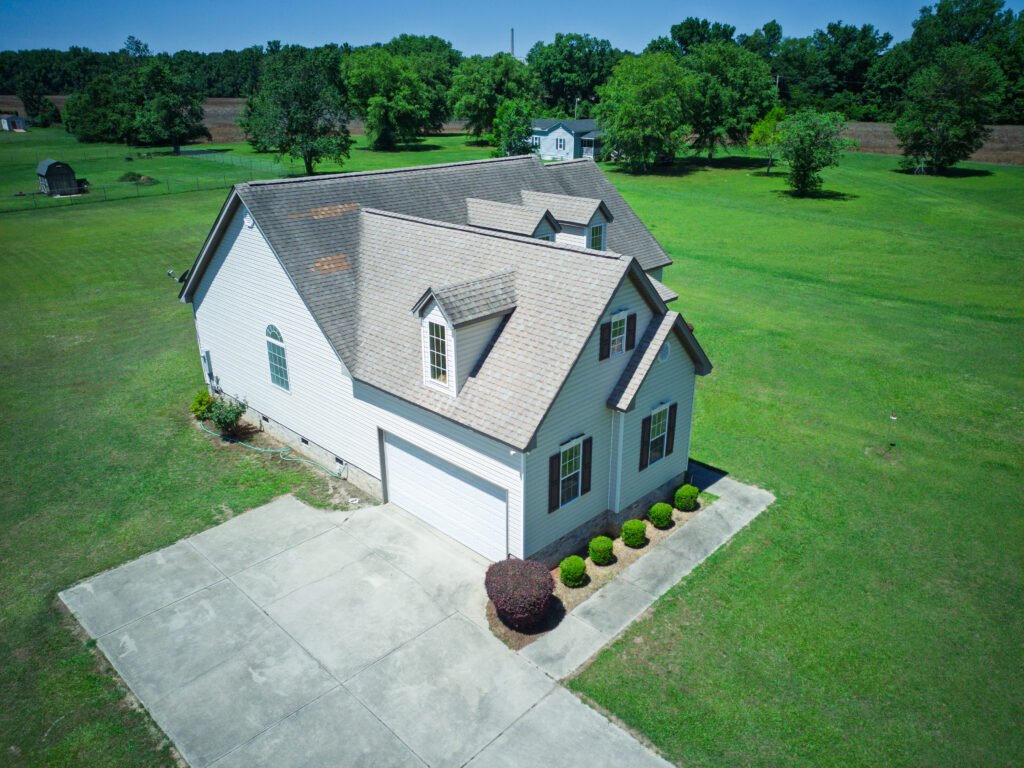
Remove cars, RVs, boats, and other vehicles from the driveway and yard if possible. Vehicles can restrict the photographer’s ability to find the best angles and compositions. Since the position of the sun cannot be changed, minimizing obstacles like vehicles is critical for maximizing photography options.
4. Outdoor Staging and Removal
Enhance curb appeal by removing or storing items such as garden hoses, trash cans, children’s toys, and excessive deck furniture. A tidy, spacious outdoor area presents better in photographs and makes the property feel more inviting.
5. Homeowner Presence
Homeowners should plan to be away during the photo shoot whenever possible, ideally for about two hours, though most shoots typically last less than 45 minutes. The absence helps the photographer work without distraction and capture the home without personal activity in the background.
6. Lighting Checks
Before the photographer arrives, check all light bulbs and fixtures. Replace burnt-out light bulbs and ensure every fixture is functioning properly. Good lighting improves photo quality and can highlight the home’s features effectively.
7. Quick Fixes and Last-Minute Details
If time is limited, moving light clutter from prominent areas (such as countertops) to less visible rooms can help reduce distractions. However, countertop clutter is difficult to manage quickly and does not photograph well, so thorough clearing beforehand is best.
8. Scheduling and Natural Light Optimization
Coordinate with the photographer to schedule the shoot during mid-morning or late afternoon. These times offer optimal natural light conditions. While midday shots can be challenging due to the contrast between outdoor and indoor light, skilled photographers can use bracketing techniques to balance exposure.
9. Common Mistakes to Avoid
Do not leave clutter or personal photos on walls and surfaces. Remember the goal is to show the home in its best light and to allow potential buyers to envision themselves living there, rather than reminding them of current owners’ personal lives.
10. Ensuring Proper Lighting
Real estate agents should communicate with homeowners about lighting requirements before the shoot is scheduled and double-check again the day prior. Many professional photographers carry extra light bulbs and fixtures to address last-minute issues on site.
11. Additional Considerations
Remove old or worn window treatments if possible, as they can detract from the home’s appearance. Maintain a comfortable indoor temperature during the shoot or inform the photographer so they can dress appropriately and remain focused on their work. If a drone will be used for aerial shots, confirm the photographer has a valid FAA Part 107 Drone License, as the FAA is strictly enforcing licensing requirements for commercial drone operations including real estate photography.
By following these steps carefully, homeowners and agents can ensure that the property is presented in the best possible way, helping to attract potential buyers and achieve successful marketing results.
Want to take it up a notch? Build and curate your own checklists to prep for a shoot. Pilots, medical personnel, engineers, and professionals in most technical fields use checklists all the time.
Kyle Lee is a Real Estate, Portrait, Product, and Landscape photographer based in the Midlands of South Carolina. To book a Real Estate session, just fill out the form below. I will get back to you quickly.